Showing:

Annotations
Attributes
Diagrams
Facets
Instances
Properties
Source
Used by
Imported schema eml-access.xsd
Namespace eml://ecoinformatics.org/access-2.0.1
Annotations
'$RCSfile: eml-access.xsd,v $'
       Copyright: 1997-2002 Regents of the University of California,
                            University of New Mexico, and
                            Arizona State University
        Sponsors: National Center for Ecological Analysis and Synthesis and
                  Partnership for Interdisciplinary Studies of Coastal Oceans,
                     University of California Santa Barbara
                  Long-Term Ecological Research Network Office,
                     University of New Mexico
                  Center for Environmental Studies, Arizona State University
   Other funding: National Science Foundation (see README for details)
                  The David and Lucile Packard Foundation
     For Details: http://knb.ecoinformatics.org/

        '$Author: jones $'
          '$Date: 2004/08/05 22:42:32 $'
      '$Revision: 1.72 $'

    This program is free software; you can redistribute it and/or modify
    it under the terms of the GNU General Public License as published by
    the Free Software Foundation; either version 2 of the License, or
    (at your option) any later version.

    This program is distributed in the hope that it will be useful,
    but WITHOUT ANY WARRANTY; without even the implied warranty of
    MERCHANTABILITY or FITNESS FOR A PARTICULAR PURPOSE.  See the
    GNU General Public License for more details.

    You should have received a copy of the GNU General Public License
    along with this program; if not, write to the Free Software
    Foundation, Inc., 59 Temple Place, Suite 330, Boston, MA  02111-1307  USA
Properties
attribute form default: unqualified
element form default: unqualified
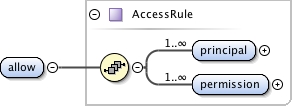
Element AccessType / allow
Namespace No namespace
Diagram
Diagram eml-access_xsd.tmp#id341 eml-access_xsd.tmp#id342 eml-access_xsd.tmp#id340
Type AccessRule
Properties
content: complex
Model principal+ , permission+
Children permission, principal
Instance
<allow>
  <principal>{1,unbounded}</principal>
  <permission>{1,unbounded}</permission>
</allow>
Source
<xs:element name="allow" type="AccessRule">
  <xs:annotation>
    <xs:appinfo>
      <doc:tooltip>Allow rule</doc:tooltip>
      <doc:summary>A rule that grants a permission
              type.</doc:summary>
      <doc:description>The allow element indicates that a particular
              user or group is granted the defined permission.</doc:description>
      <doc:example>allow</doc:example>
    </xs:appinfo>
  </xs:annotation>
</xs:element>
Element AccessRule / principal
Namespace No namespace
Diagram
Diagram
Type xs:string
Properties
content: simple
maxOccurs: unbounded
Source
<xs:element name="principal" type="xs:string" maxOccurs="unbounded">
  <xs:annotation>
    <xs:appinfo>
      <doc:tooltip>User or group</doc:tooltip>
      <doc:summary>The user or group (principal) for which the access
            control applies.</doc:summary>
      <doc:description>The principal element defines the user or group to
            which the access control rule applies. The users and groups must be
            defined in the authentication system described in the authSystem
            element.  The special principal 'public' can be used to indicate
            that any user or group has a particular access permission, thereby
            making it easier to specify that anonymous access is allowed.</doc:description>
      <doc:example>public</doc:example>
      <doc:example>uid=alice,o=LTER,dc=ecoinformatics,dc=org</doc:example>
    </xs:appinfo>
  </xs:annotation>
</xs:element>
Element AccessRule / permission
Namespace No namespace
Diagram
Diagram
Type union of(restriction of xs:string, xs:string)
Properties
content: simple
maxOccurs: unbounded
Source
<xs:element name="permission" maxOccurs="unbounded">
  <xs:annotation>
    <xs:appinfo>
      <doc:tooltip>Type of permission</doc:tooltip>
      <doc:summary>The type of permission being granted or denied.</doc:summary>
      <doc:description>The permission that is being granted or denied
            to a particular user or group for a given resource. The list of
            permissions come from a predetermined list: 'read' (allow/deny
            viewing of the resource), 'write' (allow/deny modification of the
            resource excluding access rules), 'changePermission' (ability to
            modify access rules) and 'all' (allow all of read, write, and
            changePermission). This element also allows other permission values
            that may be applicable to some other authentication systems but
            are not defined in this specification (if these other values
            are used, access rule enforcement is indeterminate outside of
            the originating system).</doc:description>
      <doc:example>read</doc:example>
    </xs:appinfo>
  </xs:annotation>
  <xs:simpleType>
    <xs:union>
      <xs:simpleType>
        <xs:restriction base="xs:string">
          <xs:enumeration value="read"/>
          <xs:enumeration value="write"/>
          <xs:enumeration value="changePermission"/>
          <xs:enumeration value="all"/>
        </xs:restriction>
      </xs:simpleType>
      <xs:simpleType>
        <xs:restriction base="xs:string"/>
      </xs:simpleType>
    </xs:union>
  </xs:simpleType>
</xs:element>
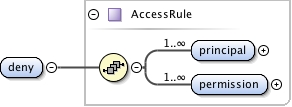
Element AccessType / deny
Namespace No namespace
Diagram
Diagram eml-access_xsd.tmp#id341 eml-access_xsd.tmp#id342 eml-access_xsd.tmp#id340
Type AccessRule
Properties
content: complex
Model principal+ , permission+
Children permission, principal
Instance
<deny>
  <principal>{1,unbounded}</principal>
  <permission>{1,unbounded}</permission>
</deny>
Source
<xs:element name="deny" type="AccessRule">
  <xs:annotation>
    <xs:appinfo>
      <doc:tooltip>Deny rule</doc:tooltip>
      <doc:summary>A rule that revokes a permission
              type.</doc:summary>
      <doc:description>The deny element indicates that a particular
              user or group is not granted the defined
              permission.</doc:description>
      <doc:example>deny</doc:example>
    </xs:appinfo>
  </xs:annotation>
</xs:element>
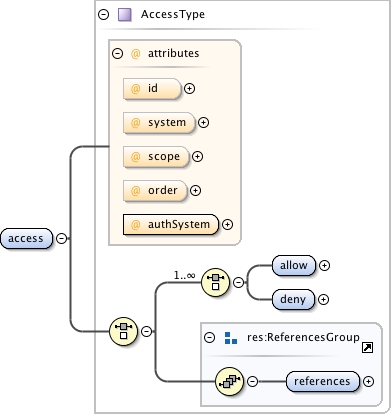
Element access
Namespace eml://ecoinformatics.org/access-2.0.1
Diagram
Diagram eml-access_xsd.tmp#id344 eml-access_xsd.tmp#id345 eml-access_xsd.tmp#id346 eml-access_xsd.tmp#id347 eml-access_xsd.tmp#id348 eml-access_xsd.tmp#id339 eml-access_xsd.tmp#id343 eml-resource_xsd.tmp#id120 eml-resource_xsd.tmp#id119 eml-access_xsd.tmp#id338
Type AccessType
Properties
content: complex
Model allow | deny | (references)
Children allow, deny, references
Instance
<access authSystem="" id="" order="allowFirst" scope="document" system="">
  <allow>{1,1}</allow>
  <deny>{1,1}</deny>
</access>
Attributes
QName Type Fixed Default Use Annotation
authSystem xs:string required
id IDType optional
order restriction of xs:string allowFirst optional
scope ScopeType document optional
system SystemType optional
Source
<xs:element name="access" type="AccessType">
  <xs:annotation>
    <xs:appinfo>
      <doc:tooltip>Access control rules</doc:tooltip>
      <doc:summary>The rules defined in this element will determine the level
        of access to a resource for the defined users and groups.</doc:summary>
      <doc:description>The access element contains a list of rules that define
        the level of access for a given data package, including both metadata
        and data.  Because the access element is declared to be of
        complex type 'AccessType', an instance must contain the elements defined
        for accessType.</doc:description>
      <doc:example>See the description of individual elements defined in
        AccessType to review each component element's rules.</doc:example>
    </xs:appinfo>
  </xs:annotation>
</xs:element>
Complex Type AccessType
Namespace eml://ecoinformatics.org/access-2.0.1
Diagram
Diagram eml-access_xsd.tmp#id344 eml-access_xsd.tmp#id345 eml-access_xsd.tmp#id346 eml-access_xsd.tmp#id347 eml-access_xsd.tmp#id348 eml-access_xsd.tmp#id339 eml-access_xsd.tmp#id343 eml-resource_xsd.tmp#id120 eml-resource_xsd.tmp#id119
Used by
Model allow | deny | (references)
Children allow, deny, references
Attributes
QName Type Fixed Default Use Annotation
authSystem xs:string required
id IDType optional
order restriction of xs:string allowFirst optional
scope ScopeType document optional
system SystemType optional
Source
<xs:complexType name="AccessType">
  <xs:annotation>
    <xs:appinfo>
      <doc:tooltip>Access control rules</doc:tooltip>
      <doc:summary>The rules defined in this element will determine the level
        of access to a resource for the defined users and groups.</doc:summary>
      <doc:description>The access element contains a list of rules that define
        the level of access for a given data package, including both metadata
        and data. The access element must contain the elements defined
        in the AccessType type.</doc:description>
    </xs:appinfo>
  </xs:annotation>
  <xs:choice>
    <xs:choice maxOccurs="unbounded">
      <xs:element name="allow" type="AccessRule">
        <xs:annotation>
          <xs:appinfo>
            <doc:tooltip>Allow rule</doc:tooltip>
            <doc:summary>A rule that grants a permission
              type.</doc:summary>
            <doc:description>The allow element indicates that a particular
              user or group is granted the defined permission.</doc:description>
            <doc:example>allow</doc:example>
          </xs:appinfo>
        </xs:annotation>
      </xs:element>
      <xs:element name="deny" type="AccessRule">
        <xs:annotation>
          <xs:appinfo>
            <doc:tooltip>Deny rule</doc:tooltip>
            <doc:summary>A rule that revokes a permission
              type.</doc:summary>
            <doc:description>The deny element indicates that a particular
              user or group is not granted the defined
              permission.</doc:description>
            <doc:example>deny</doc:example>
          </xs:appinfo>
        </xs:annotation>
      </xs:element>
    </xs:choice>
    <xs:group ref="res:ReferencesGroup"/>
  </xs:choice>
  <xs:attribute name="id" type="res:IDType" use="optional"/>
  <xs:attribute name="system" type="res:SystemType" use="optional"/>
  <xs:attribute name="scope" type="res:ScopeType" use="optional" default="document"/>
  <xs:attribute name="order" use="optional" default="allowFirst">
    <xs:annotation>
      <xs:appinfo>
        <doc:tooltip>Rule order</doc:tooltip>
        <doc:summary>The order in which the allow and deny rules should be
          applied.</doc:summary>
        <doc:description>The order attribute defines which rules should be
          applied first to obtain the desired access control. The acceptable
          values are 'allowFirst' and 'denyFirst'. If 'allowFirst' is
          specified, then all 'allow' rules are processed, and then overridden
          by all 'deny' rules.  If 'denyFirst' is specified, then all 'deny'
          rules are processed, and then overridden by all 'allow' rules.  This
          allows users to efficiently express their desired rules.</doc:description>
        <doc:example>allowFirst</doc:example>
      </xs:appinfo>
    </xs:annotation>
    <xs:simpleType>
      <xs:restriction base="xs:string">
        <xs:enumeration value="allowFirst"/>
        <xs:enumeration value="denyFirst"/>
      </xs:restriction>
    </xs:simpleType>
  </xs:attribute>
  <xs:attribute name="authSystem" type="xs:string" use="required">
    <xs:annotation>
      <xs:appinfo>
        <doc:tooltip>Authentication system</doc:tooltip>
        <doc:summary>The authentication system is used to verify the user or
          group to whom access is allowed or denied.</doc:summary>
        <doc:description>The authentication system determines the set of
          principals (users + groups) that can be used in the access control
          list, and the membership of users in groups. This element is intended
          to provide a reference to the authentication system that is used to
          verify the user or group. This reference is typically in the form
          of a URI, which includes the connection protocol, Internet host, and
          path to the authentication mechanism.</doc:description>
        <doc:example>ldap://ldap.ecoinformatics.org:389/dc=ecoinformatics,dc=org</doc:example>
      </xs:appinfo>
    </xs:annotation>
  </xs:attribute>
</xs:complexType>
Complex Type AccessRule
Namespace eml://ecoinformatics.org/access-2.0.1
Diagram
Diagram eml-access_xsd.tmp#id341 eml-access_xsd.tmp#id342
Used by
Model principal+ , permission+
Children permission, principal
Source
<xs:complexType name="AccessRule">
  <xs:annotation>
    <xs:appinfo>
      <doc:tooltip>Access Rule</doc:tooltip>
      <doc:summary>Access Rules define a user's access to a
        resource.</doc:summary>
      <doc:description>The AccessRule type defines a list of users that are
        derived from a particular authentication system (such as an LDAP
        directory), whether the user or group is allowed or denied access, the
        extent of their access (read, write , or changePermission
        access).</doc:description>
    </xs:appinfo>
  </xs:annotation>
  <xs:sequence>
    <xs:element name="principal" type="xs:string" maxOccurs="unbounded">
      <xs:annotation>
        <xs:appinfo>
          <doc:tooltip>User or group</doc:tooltip>
          <doc:summary>The user or group (principal) for which the access
            control applies.</doc:summary>
          <doc:description>The principal element defines the user or group to
            which the access control rule applies. The users and groups must be
            defined in the authentication system described in the authSystem
            element.  The special principal 'public' can be used to indicate
            that any user or group has a particular access permission, thereby
            making it easier to specify that anonymous access is allowed.</doc:description>
          <doc:example>public</doc:example>
          <doc:example>uid=alice,o=LTER,dc=ecoinformatics,dc=org</doc:example>
        </xs:appinfo>
      </xs:annotation>
    </xs:element>
    <xs:element name="permission" maxOccurs="unbounded">
      <xs:annotation>
        <xs:appinfo>
          <doc:tooltip>Type of permission</doc:tooltip>
          <doc:summary>The type of permission being granted or denied.</doc:summary>
          <doc:description>The permission that is being granted or denied
            to a particular user or group for a given resource. The list of
            permissions come from a predetermined list: 'read' (allow/deny
            viewing of the resource), 'write' (allow/deny modification of the
            resource excluding access rules), 'changePermission' (ability to
            modify access rules) and 'all' (allow all of read, write, and
            changePermission). This element also allows other permission values
            that may be applicable to some other authentication systems but
            are not defined in this specification (if these other values
            are used, access rule enforcement is indeterminate outside of
            the originating system).</doc:description>
          <doc:example>read</doc:example>
        </xs:appinfo>
      </xs:annotation>
      <xs:simpleType>
        <xs:union>
          <xs:simpleType>
            <xs:restriction base="xs:string">
              <xs:enumeration value="read"/>
              <xs:enumeration value="write"/>
              <xs:enumeration value="changePermission"/>
              <xs:enumeration value="all"/>
            </xs:restriction>
          </xs:simpleType>
          <xs:simpleType>
            <xs:restriction base="xs:string"/>
          </xs:simpleType>
        </xs:union>
      </xs:simpleType>
    </xs:element>
  </xs:sequence>
</xs:complexType>
Attribute AccessType / @id
Namespace No namespace
Type IDType
Properties
use: optional
Used by
Complex Type AccessType
Source
<xs:attribute name="id" type="res:IDType" use="optional"/>
Attribute AccessType / @system
Namespace No namespace
Type SystemType
Properties
use: optional
Used by
Complex Type AccessType
Source
<xs:attribute name="system" type="res:SystemType" use="optional"/>
Attribute AccessType / @scope
Namespace No namespace
Type ScopeType
Properties
use: optional
default: document
Facets
enumeration system
enumeration document
Used by
Complex Type AccessType
Source
<xs:attribute name="scope" type="res:ScopeType" use="optional" default="document"/>
Attribute AccessType / @order
Namespace No namespace
Type restriction of xs:string
Properties
use: optional
default: allowFirst
Facets
enumeration allowFirst
enumeration denyFirst
Used by
Complex Type AccessType
Source
<xs:attribute name="order" use="optional" default="allowFirst">
  <xs:annotation>
    <xs:appinfo>
      <doc:tooltip>Rule order</doc:tooltip>
      <doc:summary>The order in which the allow and deny rules should be
          applied.</doc:summary>
      <doc:description>The order attribute defines which rules should be
          applied first to obtain the desired access control. The acceptable
          values are 'allowFirst' and 'denyFirst'. If 'allowFirst' is
          specified, then all 'allow' rules are processed, and then overridden
          by all 'deny' rules.  If 'denyFirst' is specified, then all 'deny'
          rules are processed, and then overridden by all 'allow' rules.  This
          allows users to efficiently express their desired rules.</doc:description>
      <doc:example>allowFirst</doc:example>
    </xs:appinfo>
  </xs:annotation>
  <xs:simpleType>
    <xs:restriction base="xs:string">
      <xs:enumeration value="allowFirst"/>
      <xs:enumeration value="denyFirst"/>
    </xs:restriction>
  </xs:simpleType>
</xs:attribute>
Attribute AccessType / @authSystem
Namespace No namespace
Type xs:string
Properties
use: required
Used by
Complex Type AccessType
Source
<xs:attribute name="authSystem" type="xs:string" use="required">
  <xs:annotation>
    <xs:appinfo>
      <doc:tooltip>Authentication system</doc:tooltip>
      <doc:summary>The authentication system is used to verify the user or
          group to whom access is allowed or denied.</doc:summary>
      <doc:description>The authentication system determines the set of
          principals (users + groups) that can be used in the access control
          list, and the membership of users in groups. This element is intended
          to provide a reference to the authentication system that is used to
          verify the user or group. This reference is typically in the form
          of a URI, which includes the connection protocol, Internet host, and
          path to the authentication mechanism.</doc:description>
      <doc:example>ldap://ldap.ecoinformatics.org:389/dc=ecoinformatics,dc=org</doc:example>
    </xs:appinfo>
  </xs:annotation>
</xs:attribute>