Showing:

Annotations
Attributes
Diagrams
Facets
Instances
Properties
Source
Used by
Main schema sbc_siteDescription.xsd
Namespace No namespace
Properties
attribute form default: unqualified
element form default: qualified
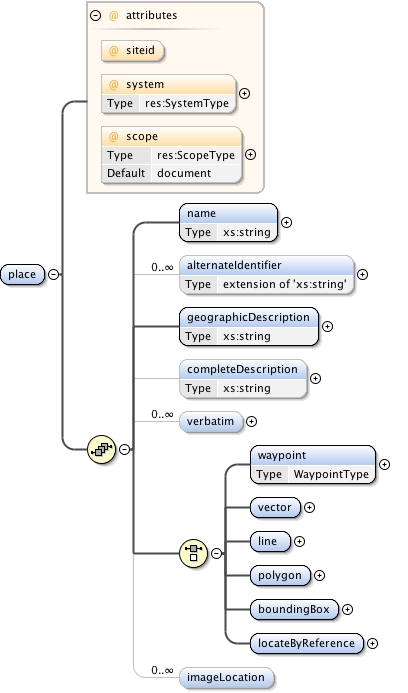
Element place
Namespace No namespace
Annotations
This schema is to describe anywhere that samples are collected. These could be a waypoint, vector, line, 
  plot, transect, area or bounding-box. Each of these has defintions as used by SBC.
It imports 2 EML files, the resource.xsd and the documentation.xsd. 
resource.xsd has some type defintions which might be of use, system and scope. But it also imports several other
EML files, which makes this schema somewhat bloated. Documentation should be self-explanatory. This documentation
generated by Oxygen (schema editor), and it does not have the capacity to use the doc namespace under xs:appinfo.
To see the examples, look at the "source", under doc:example
Diagram
Diagram sbc_siteDescription_xsd.tmp#id95 sbc_siteDescription_xsd.tmp#id96 sbc_siteDescription_xsd.tmp#id97 sbc_siteDescription_xsd.tmp#id10 sbc_siteDescription_xsd.tmp#id11 sbc_siteDescription_xsd.tmp#id16 sbc_siteDescription_xsd.tmp#id17 sbc_siteDescription_xsd.tmp#id18 sbc_siteDescription_xsd.tmp#id23 sbc_siteDescription_xsd.tmp#id49 sbc_siteDescription_xsd.tmp#id66 sbc_siteDescription_xsd.tmp#id70 sbc_siteDescription_xsd.tmp#id77 sbc_siteDescription_xsd.tmp#id89 sbc_siteDescription_xsd.tmp#id94
Properties
content: complex
Model name , alternateIdentifier* , geographicDescription , completeDescription{0,1} , verbatim* , (waypoint | vector | line | polygon | boundingBox | locateByReference) , imageLocation*
Children alternateIdentifier, boundingBox, completeDescription, geographicDescription, imageLocation, line, locateByReference, name, polygon, vector, verbatim, waypoint
Instance
<place scope="document" siteid="" system="">
  <name>{1,1}</name>
  <alternateIdentifier scope="document" system="">{0,unbounded}</alternateIdentifier>
  <geographicDescription>{1,1}</geographicDescription>
  <completeDescription>{0,1}</completeDescription>
  <verbatim date="" useType="">{0,unbounded}</verbatim>
  <imageLocation>{0,unbounded}</imageLocation>
</place>
Attributes
QName Type Fixed Default Use Annotation
scope ScopeType document optional
siteid optional
system SystemType optional
Source
<xs:element name="place">
  <xs:annotation>
    <xs:documentation>This schema is to describe anywhere that samples are collected. These could be a waypoint, vector, line, 
        plot, transect, area or bounding-box. Each of these has defintions as used by SBC.
      It imports 2 EML files, the resource.xsd and the documentation.xsd. 
      resource.xsd has some type defintions which might be of use, system and scope. But it also imports several other
      EML files, which makes this schema somewhat bloated. Documentation should be self-explanatory. This documentation
      generated by Oxygen (schema editor), and it does not have the capacity to use the doc namespace under xs:appinfo.
      To see the examples, look at the "source", under doc:example</xs:documentation>
  </xs:annotation>
  <xs:complexType>
    <xs:sequence>
      <xs:element name="name" type="xs:string"/>
      <xs:element name="alternateIdentifier" minOccurs="0" maxOccurs="unbounded">
        <xs:annotation>
          <xs:documentation>Other identifiers for this location</xs:documentation>
          <xs:appinfo>
            <doc:tooltip>Other identifiers for this location</doc:tooltip>
            <doc:summary>Many of SBC's sampling sites are purposely co-located with tje sampling sites of other projects. 
              If known, these should be listed here.</doc:summary>
            <doc:description>
            </doc:description>
            <doc:example>SCCOOS: sbharbor</doc:example>
            <doc:example>Plumes and Blooms: station4</doc:example>
            <doc:example>USGS: 11199000</doc:example>
          </xs:appinfo>
        </xs:annotation>
        <xs:complexType>
          <xs:simpleContent>
            <xs:extension base="xs:string">
              <xs:attribute name="system" type="res:SystemType" use="optional"/>
              <xs:attribute name="scope" type="res:ScopeType" use="optional" default="document"/>
            </xs:extension>
          </xs:simpleContent>
        </xs:complexType>
      </xs:element>
      <xs:element name="geographicDescription" type="xs:string">
        <xs:annotation>
          <xs:appinfo>
            <doc:tooltip>Description of geographic extent, to be exported to EML geographicDescription field</doc:tooltip>
            <doc:summary>Short description of the place that is suitable for public viewing. Include associated geographic names, landmarks, artificial markers, and any ancillary info which cannot be coded.  Use this field to further restrict the location, e.g, two transects share the same waypoint-starting gPoint, but are actually separated by few meters</doc:summary>
            <doc:description>
            </doc:description>
            <doc:example>Examples include, "Manistee River watershed", "transect beginning at eyebolt at far west end of Naples reef and extending due east", or "Arroyo Burro Creek between State Street bridge and the beach", "cruise station also sampled by Plumes and blooms project and by CCE"</doc:example>
          </xs:appinfo>
        </xs:annotation>
      </xs:element>
      <xs:element name="completeDescription" type="xs:string" minOccurs="0">
        <xs:annotation>
          <xs:appinfo>
            <doc:tooltip>Complete description of the place</doc:tooltip>
            <doc:summary>This description is for all the material, including what is useful for field personnel to locate the site during sampling. It can include anything from the geographic (public) description, plus other info as necessary, for example recent descriptions of biota or substrates that not necessary in the public description. Since the required sibling element geographicDescription may have all that is required to describe a place, this element is optional.</doc:summary>
            <doc:description>
            </doc:description>
            <doc:example>Examples include, "Manistee River watershed", "transect beginning at eyebolt at far west end of Naples reef and cruisextending due east", or "in 2009 sand was moving in",  "another transect shares this endpoint but is separated by few meters"</doc:example>
          </xs:appinfo>
        </xs:annotation>
      </xs:element>
      <xs:element name="verbatim" minOccurs="0" maxOccurs="unbounded">
        <xs:annotation>
          <xs:appinfo>
            <doc:tooltip>Information as received</doc:tooltip>
            <doc:summary>locations, especially lats and longs are usually kept in degree + minute with compass direction attached, and are converted to decimals for this application. Store the original strings here.</doc:summary>
          </xs:appinfo>
        </xs:annotation>
        <xs:complexType>
          <xs:sequence>
            <xs:element name="infoReceived">
              <xs:annotation>
                <xs:appinfo>
                  <doc:example>34deg 15.8 min N x 119deg 32.45 W</doc:example>
                </xs:appinfo>
              </xs:annotation>
            </xs:element>
            <xs:element name="notesInfoReceived">
              <xs:annotation>
                <xs:appinfo>
                  <doc:example>per clint nelson's excel sheet, 2007-01-01</doc:example>
                </xs:appinfo>
              </xs:annotation>
            </xs:element>
          </xs:sequence>
          <xs:attribute name="date" type="xs:date" use="optional"/>
          <xs:attribute name="useType" type="xs:string" use="optional"/>
        </xs:complexType>
      </xs:element>
      <xs:choice>
        <xs:element name="waypoint" type="WaypointType"/>
        <xs:element name="vector">
          <xs:annotation>
            <xs:appinfo>
              <doc:tooltip>Used for a sampling site designated by a starting lat-lon pair, a direction, length and width</doc:tooltip>
              <doc:summary>census transects are usually defined by an endpoint, with a compass direction, length and width. The endpoint is a WaypointType, the direction, length and width are decimals. units are stored in the element's attribute</doc:summary>
            </xs:appinfo>
            <xs:documentation>a straight line defined by an endpoint, direction, length and width</xs:documentation>
          </xs:annotation>
          <xs:complexType>
            <xs:sequence>
              <xs:element name="endPoint" type="WaypointType">
                <xs:annotation>
                  <xs:documentation>endpoint is a WaypointType</xs:documentation>
                </xs:annotation>
              </xs:element>
              <xs:element name="direction">
                <xs:complexType>
                  <xs:simpleContent>
                    <xs:extension base="xs:decimal">
                      <xs:attribute name="unit" use="optional"/>
                    </xs:extension>
                  </xs:simpleContent>
                </xs:complexType>
              </xs:element>
              <xs:element name="length">
                <xs:complexType>
                  <xs:simpleContent>
                    <xs:extension base="xs:decimal">
                      <xs:attribute name="unit" use="optional"/>
                    </xs:extension>
                  </xs:simpleContent>
                </xs:complexType>
              </xs:element>
              <xs:element name="width">
                <xs:complexType>
                  <xs:simpleContent>
                    <xs:extension base="xs:decimal">
                      <xs:attribute name="unit" use="optional"/>
                    </xs:extension>
                  </xs:simpleContent>
                </xs:complexType>
              </xs:element>
              <xs:element name="altitudeRange" minOccurs="0">
                <xs:complexType>
                  <xs:sequence>
                    <xs:element name="minimum" type="xs:decimal"/>
                    <xs:element name="maximum" type="xs:decimal"/>
                  </xs:sequence>
                  <xs:attribute name="datum" type="xs:string" use="optional"/>
                  <xs:attribute name="unit" type="xs:string" use="optional"/>
                </xs:complexType>
              </xs:element>
              <xs:element name="plots" minOccurs="0">
                <xs:annotation>
                  <xs:appinfo>
                    <doc:tooltip>Used for defining plots along a vector-type transect</doc:tooltip>
                    <doc:summary>not entirely sure how this information will be used. usually upc data is collected in 1-m quadrats along the same transect as large-animal censuses, alternating sides at approx 5m intervals, and numbered a,b,c or 1,2,3.</doc:summary>
                  </xs:appinfo>
                  <xs:documentation>maybe remove this, and define plots indivually using locateByReference instead.</xs:documentation>
                </xs:annotation>
                <xs:complexType>
                  <xs:sequence>
                    <xs:element name="plot" maxOccurs="unbounded">
                      <xs:complexType>
                        <xs:sequence>
                          <xs:element name="plotName"/>
                          <xs:element name="position"/>
                        </xs:sequence>
                      </xs:complexType>
                    </xs:element>
                  </xs:sequence>
                </xs:complexType>
              </xs:element>
            </xs:sequence>
          </xs:complexType>
        </xs:element>
        <xs:element name="line">
          <xs:annotation>
            <xs:appinfo>
              <doc:tooltip>Describe a line or sampling transect by one or more lat-lon pairs</doc:tooltip>
              <doc:summary>This tree could be used for any sampling line composed of at least 2 endpoints (and may include jogs). examples are ship transects, along shore transects. Tree can aslo be used for creeks or tributaries. Use either a sequence of GPointTypes, or a gml lineString (called a PositionList here)</doc:summary>
            </xs:appinfo>
            <xs:documentation>a string of at least 2 waypoints, or an unclosed curve</xs:documentation>
          </xs:annotation>
          <xs:complexType>
            <xs:choice>
              <xs:element name="waypoint" type="WaypointType" minOccurs="2" maxOccurs="unbounded"/>
              <xs:element name="gmlPositionList">
                <xs:annotation>
                  <xs:appinfo>
                    <doc:tooltip>an alternative to separately coded lats and longs. gml string could go here</doc:tooltip>
                    <doc:summary>This field should be composed of at least 2 "lon lat" pairs (ie, x y, x y, x y) to denone. same caveats apply as for gmlPosition</doc:summary>
                    <doc:example>-120.8678 34.2222, -120.9000, 34.333</doc:example>
                  </xs:appinfo>
                </xs:annotation>
                <xs:complexType>
                  <xs:attribute name="dimension" default="2"/>
                </xs:complexType>
              </xs:element>
            </xs:choice>
          </xs:complexType>
        </xs:element>
        <xs:element name="polygon">
          <xs:annotation>
            <xs:appinfo>
              <doc:tooltip>Polygon data set</doc:tooltip>
              <doc:summary>This construct creates a spatial ring with a hollow center.</doc:summary>
              <doc:description>This construct creates a spatial ring with a hollow center.  This doughnut shape is specified by the outer ring (datasetGPolygonOuterRing) and the inner exclusion zone (datasetGPolygonExclusionGRing) which can be thought of as the hole in the center of a doughnut.  This is useful for defining areas such as the shores of a pond where you only want to specify the shore excluding the pond itself.</doc:description>
              <doc:example>Please see the individual sub-fields for specificexamples.</doc:example>
            </xs:appinfo>
            <xs:documentation>a closed shape with/without an excluded area</xs:documentation>
          </xs:annotation>
          <xs:complexType>
            <xs:sequence>
              <xs:element name="gPolygonOuterGRing">
                <xs:annotation>
                  <xs:appinfo>
                    <doc:tooltip>Outer polygon</doc:tooltip>
                    <doc:summary>The outer containment loop of a GPolygon.</doc:summary>
                    <doc:description>The outer containment loop of a datasetGPolygon.  This is the outer part of the doughnut shape that encompasses the broadest area of coverage</doc:description>
                  </xs:appinfo>
                </xs:annotation>
                <xs:complexType>
                  <xs:choice>
                    <xs:sequence>
                      <xs:element name="gPoint" type="GPointType" minOccurs="3" maxOccurs="unbounded"/>
                    </xs:sequence>
                    <xs:element name="gmlRing"/>
                  </xs:choice>
                </xs:complexType>
              </xs:element>
              <xs:element name="gPolygonExclusionGRing" minOccurs="0" maxOccurs="unbounded">
                <xs:annotation>
                  <xs:appinfo>
                    <doc:tooltip>Exclusion polygon</doc:tooltip>
                    <doc:summary>Data Set G-Polygon Exclusion G-Ring, the closed nonintersecting boundary of a void area (or hole in an interior area).</doc:summary>
                    <doc:description>Data Set G-Polygon Exclusion G-Ring, the closed nonintersecting boundary of a void area (or hole in an interior area).  This is the center of the doughnut shape created by the datasetGPolygon. How do you inforce non-intersecting??</doc:description>
                  </xs:appinfo>
                  <xs:documentation>the void area, or center of the doughnut.</xs:documentation>
                </xs:annotation>
                <xs:complexType>
                  <xs:choice>
                    <xs:element name="gPoint" type="GPointType" maxOccurs="unbounded"/>
                    <xs:element name="gmlRing"/>
                  </xs:choice>
                </xs:complexType>
              </xs:element>
            </xs:sequence>
          </xs:complexType>
        </xs:element>
        <xs:element name="boundingBox">
          <xs:annotation>
            <xs:documentation>copied from EML geographicCoverage, 
              but altitude moved and datums added</xs:documentation>
          </xs:annotation>
          <xs:complexType>
            <xs:sequence>
              <xs:element name="boundingCoordinates">
                <xs:complexType>
                  <xs:sequence>
                    <xs:element name="westBoundingCoordinate" type="xs:string"/>
                    <xs:element name="eastBoundingCoordinate" type="xs:string"/>
                    <xs:element name="northBoundingCoordinate" type="xs:string"/>
                    <xs:element name="southBoundingCoordinate" type="xs:string"/>
                  </xs:sequence>
                  <xs:attribute name="datum" use="optional"/>
                </xs:complexType>
              </xs:element>
              <xs:element name="boundingAltitudes" minOccurs="0">
                <xs:complexType>
                  <xs:sequence>
                    <xs:element name="altitudeMinimum" type="xs:string"/>
                    <xs:element name="altitudeMaximum" type="xs:string"/>
                    <xs:element name="altitudeUnits" type="xs:string"/>
                  </xs:sequence>
                  <xs:attribute name="datum" use="optional"/>
                </xs:complexType>
              </xs:element>
            </xs:sequence>
          </xs:complexType>
        </xs:element>
        <xs:element name="locateByReference">
          <xs:annotation>
            <xs:appinfo>
              <doc:tooltip>an alternative to separately coded lats and longs. Use this element for a point that is located by reference to another place</doc:tooltip>
              <doc:summary>locations can be specified as "8meters along transect A", or "from aqm, 10meters at 340deg".  transect A (or aqm) are places with existing descriptions</doc:summary>
              <doc:example>10 ft SW of the big rock at the foot of goleta pier</doc:example>
              <doc:example>8meters along transect LTRAQ1</doc:example>
            </xs:appinfo>
            <xs:documentation>describe this place using its relationship to another place. no attempt at referential integrity.</xs:documentation>
          </xs:annotation>
          <xs:complexType>
            <xs:sequence>
              <xs:element name="referenceIdentifier">
                <xs:annotation>
                  <xs:appinfo>
                    <doc:tooltip>The id of the place that will be referenced</doc:tooltip>
                    <doc:summary>the parent place of this place. for example, the id for the transect that this plot is located along</doc:summary>
                    <doc:example>LTRAQ1</doc:example>
                  </xs:appinfo>
                  <xs:documentation>The id of the place that will be referenced</xs:documentation>
                </xs:annotation>
                <xs:complexType>
                  <xs:attribute name="system"/>
                  <xs:attribute name="scope"/>
                </xs:complexType>
              </xs:element>
              <xs:element name="locatorString">
                <xs:annotation>
                  <xs:documentation>How to find this place from the reference place</xs:documentation>
                  <xs:appinfo>
                    <doc:tooltip>How to find this place from the reference place</doc:tooltip>
                    <doc:summary>This element typed xs:string to accomodate narrative descriptions</doc:summary>
                    <doc:example>10m at 340deg</doc:example>
                    <doc:example>8m</doc:example>
                  </xs:appinfo>
                </xs:annotation>
              </xs:element>
            </xs:sequence>
          </xs:complexType>
        </xs:element>
      </xs:choice>
      <xs:element name="imageLocation" minOccurs="0" maxOccurs="unbounded">
        <xs:annotation>
          <xs:documentation>path on the file server or a url</xs:documentation>
          <xs:appinfo>
            <doc:tooltip>a path to an image file to accompany this place, either on the fileserver or a url</doc:tooltip>
            <doc:summary>Some site description documents contain a small image or a crude map of the site. these should be converted to standard image formats.</doc:summary>
            <doc:example>/internal//reef/working/site_descriptions/ab04.jog</doc:example>
            <doc:example>8m</doc:example>
          </xs:appinfo>
        </xs:annotation>
      </xs:element>
    </xs:sequence>
    <xs:attribute name="siteid"/>
    <xs:attribute name="system" type="res:SystemType" use="optional"/>
    <xs:attribute name="scope" type="res:ScopeType" use="optional" default="document"/>
  </xs:complexType>
</xs:element>
Element place / name
Namespace No namespace
Diagram
Diagram
Type xs:string
Properties
content: simple
Source
<xs:element name="name" type="xs:string"/>
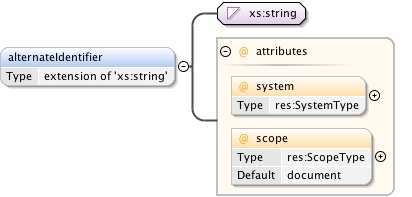
Element place / alternateIdentifier
Namespace No namespace
Annotations
Other identifiers for this location
Diagram
Diagram sbc_siteDescription_xsd.tmp#id12 sbc_siteDescription_xsd.tmp#id14
Type extension of xs:string
Properties
content: complex
minOccurs: 0
maxOccurs: unbounded
Attributes
QName Type Fixed Default Use Annotation
scope ScopeType document optional
system SystemType optional
Source
<xs:element name="alternateIdentifier" minOccurs="0" maxOccurs="unbounded">
  <xs:annotation>
    <xs:documentation>Other identifiers for this location</xs:documentation>
    <xs:appinfo>
      <doc:tooltip>Other identifiers for this location</doc:tooltip>
      <doc:summary>Many of SBC's sampling sites are purposely co-located with tje sampling sites of other projects. 
              If known, these should be listed here.</doc:summary>
      <doc:description>
      </doc:description>
      <doc:example>SCCOOS: sbharbor</doc:example>
      <doc:example>Plumes and Blooms: station4</doc:example>
      <doc:example>USGS: 11199000</doc:example>
    </xs:appinfo>
  </xs:annotation>
  <xs:complexType>
    <xs:simpleContent>
      <xs:extension base="xs:string">
        <xs:attribute name="system" type="res:SystemType" use="optional"/>
        <xs:attribute name="scope" type="res:ScopeType" use="optional" default="document"/>
      </xs:extension>
    </xs:simpleContent>
  </xs:complexType>
</xs:element>
Element place / geographicDescription
Namespace No namespace
Diagram
Diagram
Type xs:string
Properties
content: simple
Source
<xs:element name="geographicDescription" type="xs:string">
  <xs:annotation>
    <xs:appinfo>
      <doc:tooltip>Description of geographic extent, to be exported to EML geographicDescription field</doc:tooltip>
      <doc:summary>Short description of the place that is suitable for public viewing. Include associated geographic names, landmarks, artificial markers, and any ancillary info which cannot be coded.  Use this field to further restrict the location, e.g, two transects share the same waypoint-starting gPoint, but are actually separated by few meters</doc:summary>
      <doc:description>
      </doc:description>
      <doc:example>Examples include, "Manistee River watershed", "transect beginning at eyebolt at far west end of Naples reef and extending due east", or "Arroyo Burro Creek between State Street bridge and the beach", "cruise station also sampled by Plumes and blooms project and by CCE"</doc:example>
    </xs:appinfo>
  </xs:annotation>
</xs:element>
Element place / completeDescription
Namespace No namespace
Diagram
Diagram
Type xs:string
Properties
content: simple
minOccurs: 0
Source
<xs:element name="completeDescription" type="xs:string" minOccurs="0">
  <xs:annotation>
    <xs:appinfo>
      <doc:tooltip>Complete description of the place</doc:tooltip>
      <doc:summary>This description is for all the material, including what is useful for field personnel to locate the site during sampling. It can include anything from the geographic (public) description, plus other info as necessary, for example recent descriptions of biota or substrates that not necessary in the public description. Since the required sibling element geographicDescription may have all that is required to describe a place, this element is optional.</doc:summary>
      <doc:description>
      </doc:description>
      <doc:example>Examples include, "Manistee River watershed", "transect beginning at eyebolt at far west end of Naples reef and cruisextending due east", or "in 2009 sand was moving in",  "another transect shares this endpoint but is separated by few meters"</doc:example>
    </xs:appinfo>
  </xs:annotation>
</xs:element>
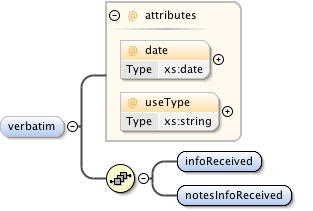
Element place / verbatim
Namespace No namespace
Diagram
Diagram sbc_siteDescription_xsd.tmp#id21 sbc_siteDescription_xsd.tmp#id22 sbc_siteDescription_xsd.tmp#id19 sbc_siteDescription_xsd.tmp#id20
Properties
content: complex
minOccurs: 0
maxOccurs: unbounded
Model infoReceived , notesInfoReceived
Children infoReceived, notesInfoReceived
Instance
<verbatim date="" useType="">
  <infoReceived>{1,1}</infoReceived>
  <notesInfoReceived>{1,1}</notesInfoReceived>
</verbatim>
Attributes
QName Type Fixed Default Use Annotation
date xs:date optional
useType xs:string optional
Source
<xs:element name="verbatim" minOccurs="0" maxOccurs="unbounded">
  <xs:annotation>
    <xs:appinfo>
      <doc:tooltip>Information as received</doc:tooltip>
      <doc:summary>locations, especially lats and longs are usually kept in degree + minute with compass direction attached, and are converted to decimals for this application. Store the original strings here.</doc:summary>
    </xs:appinfo>
  </xs:annotation>
  <xs:complexType>
    <xs:sequence>
      <xs:element name="infoReceived">
        <xs:annotation>
          <xs:appinfo>
            <doc:example>34deg 15.8 min N x 119deg 32.45 W</doc:example>
          </xs:appinfo>
        </xs:annotation>
      </xs:element>
      <xs:element name="notesInfoReceived">
        <xs:annotation>
          <xs:appinfo>
            <doc:example>per clint nelson's excel sheet, 2007-01-01</doc:example>
          </xs:appinfo>
        </xs:annotation>
      </xs:element>
    </xs:sequence>
    <xs:attribute name="date" type="xs:date" use="optional"/>
    <xs:attribute name="useType" type="xs:string" use="optional"/>
  </xs:complexType>
</xs:element>
Element place / verbatim / infoReceived
Namespace No namespace
Diagram
Diagram
Source
<xs:element name="infoReceived">
  <xs:annotation>
    <xs:appinfo>
      <doc:example>34deg 15.8 min N x 119deg 32.45 W</doc:example>
    </xs:appinfo>
  </xs:annotation>
</xs:element>
Element place / verbatim / notesInfoReceived
Namespace No namespace
Diagram
Diagram
Source
<xs:element name="notesInfoReceived">
  <xs:annotation>
    <xs:appinfo>
      <doc:example>per clint nelson's excel sheet, 2007-01-01</doc:example>
    </xs:appinfo>
  </xs:annotation>
</xs:element>
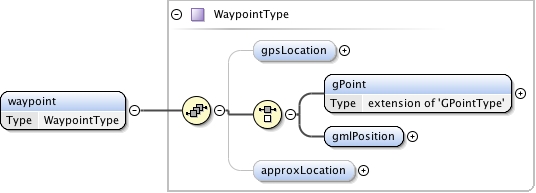
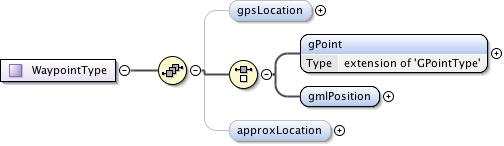
Element place / waypoint
Namespace No namespace
Diagram
Diagram sbc_siteDescription_xsd.tmp#id25 sbc_siteDescription_xsd.tmp#id33 sbc_siteDescription_xsd.tmp#id43 sbc_siteDescription_xsd.tmp#id46 sbc_siteDescription_xsd.tmp#id24
Type WaypointType
Properties
content: complex
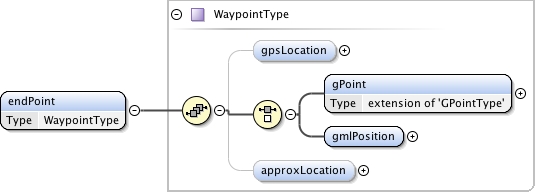
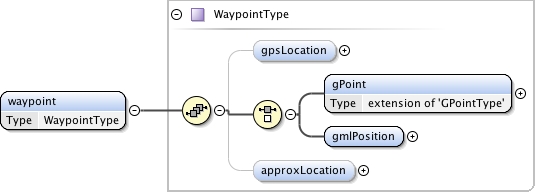
Model gpsLocation{0,1} , (gPoint | gmlPosition) , approxLocation{0,1}
Children approxLocation, gPoint, gmlPosition, gpsLocation
Instance
<waypoint>
  <gpsLocation>{0,1}</gpsLocation>
  <approxLocation>{0,1}</approxLocation>
</waypoint>
Source
<xs:element name="waypoint" type="WaypointType"/>
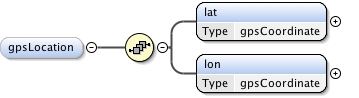
Element WaypointType / gpsLocation
Namespace No namespace
Annotations
The point as it came off the gps unit. these fields can be transformed into gPoints
Diagram
Diagram sbc_siteDescription_xsd.tmp#id26 sbc_siteDescription_xsd.tmp#id32
Properties
content: complex
minOccurs: 0
Model lat , lon
Children lat, lon
Instance
<gpsLocation>
  <lat datum="">{1,1}</lat>
  <lon datum="">{1,1}</lon>
</gpsLocation>
Source
<xs:element name="gpsLocation" minOccurs="0">
  <xs:annotation>
    <xs:documentation>The point as it came off the gps unit. these fields can be transformed into gPoints</xs:documentation>
  </xs:annotation>
  <xs:complexType>
    <xs:sequence>
      <xs:element name="lat" type="gpsCoordinate"/>
      <xs:element name="lon" type="gpsCoordinate"/>
    </xs:sequence>
  </xs:complexType>
</xs:element>
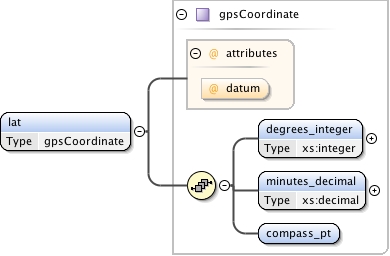
Element WaypointType / gpsLocation / lat
Namespace No namespace
Diagram
Diagram sbc_siteDescription_xsd.tmp#id31 sbc_siteDescription_xsd.tmp#id28 sbc_siteDescription_xsd.tmp#id29 sbc_siteDescription_xsd.tmp#id30 sbc_siteDescription_xsd.tmp#id27
Type gpsCoordinate
Properties
content: complex
Model degrees_integer , minutes_decimal , compass_pt
Children compass_pt, degrees_integer, minutes_decimal
Instance
<lat datum="">
  <degrees_integer>{1,1}</degrees_integer>
  <minutes_decimal>{1,1}</minutes_decimal>
  <compass_pt>{1,1}</compass_pt>
</lat>
Attributes
QName Type Fixed Default Use Annotation
datum optional
Source
<xs:element name="lat" type="gpsCoordinate"/>
Element gpsCoordinate / degrees_integer
Namespace No namespace
Diagram
Diagram
Type xs:integer
Properties
content: simple
Source
<xs:element name="degrees_integer" type="xs:integer"/>
Element gpsCoordinate / minutes_decimal
Namespace No namespace
Diagram
Diagram
Type xs:decimal
Properties
content: simple
Source
<xs:element name="minutes_decimal" type="xs:decimal"/>
Element gpsCoordinate / compass_pt
Namespace No namespace
Diagram
Diagram
Source
<xs:element name="compass_pt"/>
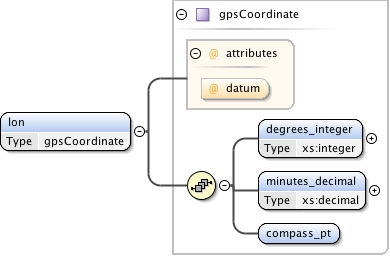
Element WaypointType / gpsLocation / lon
Namespace No namespace
Diagram
Diagram sbc_siteDescription_xsd.tmp#id31 sbc_siteDescription_xsd.tmp#id28 sbc_siteDescription_xsd.tmp#id29 sbc_siteDescription_xsd.tmp#id30 sbc_siteDescription_xsd.tmp#id27
Type gpsCoordinate
Properties
content: complex
Model degrees_integer , minutes_decimal , compass_pt
Children compass_pt, degrees_integer, minutes_decimal
Instance
<lon datum="">
  <degrees_integer>{1,1}</degrees_integer>
  <minutes_decimal>{1,1}</minutes_decimal>
  <compass_pt>{1,1}</compass_pt>
</lon>
Attributes
QName Type Fixed Default Use Annotation
datum optional
Source
<xs:element name="lon" type="gpsCoordinate"/>
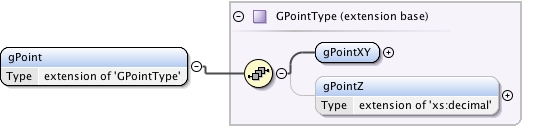
Element WaypointType / gPoint
Namespace No namespace
Diagram
Diagram sbc_siteDescription_xsd.tmp#id35 sbc_siteDescription_xsd.tmp#id40 sbc_siteDescription_xsd.tmp#id34
Type extension of GPointType
Type hierarchy
Properties
content: complex
Model gPointXY , gPointZ{0,1}
Children gPointXY, gPointZ
Instance
<gPoint>
  <gPointXY datum="" unit="degree">{1,1}</gPointXY>
  <gPointZ datum="" unit="meter">{0,1}</gPointZ>
</gPoint>
Source
<xs:element name="gPoint">
  <xs:complexType>
    <xs:complexContent>
      <xs:extension base="GPointType"/>
    </xs:complexContent>
  </xs:complexType>
</xs:element>
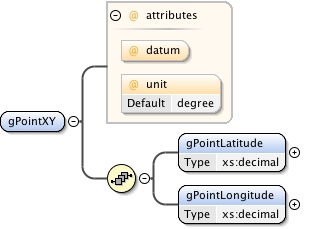
Element GPointType / gPointXY
Namespace No namespace
Diagram
Diagram sbc_siteDescription_xsd.tmp#id38 sbc_siteDescription_xsd.tmp#id39 sbc_siteDescription_xsd.tmp#id36 sbc_siteDescription_xsd.tmp#id37
Properties
content: complex
Model gPointLatitude , gPointLongitude
Children gPointLatitude, gPointLongitude
Instance
<gPointXY datum="" unit="degree">
  <gPointLatitude>{1,1}</gPointLatitude>
  <gPointLongitude>{1,1}</gPointLongitude>
</gPointXY>
Attributes
QName Type Fixed Default Use Annotation
datum optional
unit degree optional
Source
<xs:element name="gPointXY">
  <xs:complexType>
    <xs:sequence>
      <xs:element name="gPointLatitude" type="xs:decimal">
        <xs:annotation>
          <xs:appinfo>
            <doc:tooltip>G-Point Latitude</doc:tooltip>
            <doc:summary/>
            <doc:description>The latitude of a point. Use decimal degrees, positive = North</doc:description>
          </xs:appinfo>
        </xs:annotation>
      </xs:element>
      <xs:element name="gPointLongitude" type="xs:decimal">
        <xs:annotation>
          <xs:appinfo>
            <doc:tooltip>G-Point Longitude</doc:tooltip>
            <doc:summary/>
            <doc:description>The longitude of a point Use decimal degrees, positive = East.</doc:description>
          </xs:appinfo>
        </xs:annotation>
      </xs:element>
    </xs:sequence>
    <xs:attribute name="datum" use="optional"/>
    <xs:attribute name="unit" default="degree"/>
  </xs:complexType>
</xs:element>
Element GPointType / gPointXY / gPointLatitude
Namespace No namespace
Diagram
Diagram
Type xs:decimal
Properties
content: simple
Source
<xs:element name="gPointLatitude" type="xs:decimal">
  <xs:annotation>
    <xs:appinfo>
      <doc:tooltip>G-Point Latitude</doc:tooltip>
      <doc:summary/>
      <doc:description>The latitude of a point. Use decimal degrees, positive = North</doc:description>
    </xs:appinfo>
  </xs:annotation>
</xs:element>
Element GPointType / gPointXY / gPointLongitude
Namespace No namespace
Diagram
Diagram
Type xs:decimal
Properties
content: simple
Source
<xs:element name="gPointLongitude" type="xs:decimal">
  <xs:annotation>
    <xs:appinfo>
      <doc:tooltip>G-Point Longitude</doc:tooltip>
      <doc:summary/>
      <doc:description>The longitude of a point Use decimal degrees, positive = East.</doc:description>
    </xs:appinfo>
  </xs:annotation>
</xs:element>
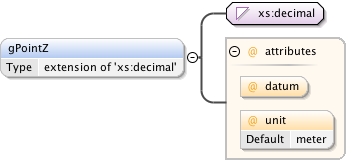
Element GPointType / gPointZ
Namespace No namespace
Diagram
Diagram sbc_siteDescription_xsd.tmp#id41 sbc_siteDescription_xsd.tmp#id42
Type extension of xs:decimal
Properties
content: complex
minOccurs: 0
Attributes
QName Type Fixed Default Use Annotation
datum optional
unit meter optional
Source
<xs:element name="gPointZ" minOccurs="0">
  <xs:complexType>
    <xs:simpleContent>
      <xs:extension base="xs:decimal">
        <xs:attribute name="datum" use="optional"/>
        <xs:attribute name="unit" default="meter"/>
      </xs:extension>
    </xs:simpleContent>
  </xs:complexType>
</xs:element>
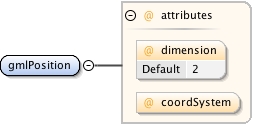
Element WaypointType / gmlPosition
Namespace No namespace
Diagram
Diagram sbc_siteDescription_xsd.tmp#id44 sbc_siteDescription_xsd.tmp#id45
Properties
content: complex
Attributes
QName Type Fixed Default Use Annotation
coordSystem optional
dimension 2 optional
Source
<xs:element name="gmlPosition">
  <xs:annotation>
    <xs:appinfo>
      <doc:tooltip>an alternative to separately coded lats and longs. gml string could go here</doc:tooltip>
      <doc:summary>This field should be a "lon lat" pair (ie, x y, if 2D), or a "lon lat alt" (x y z, if 3D). consider a validation pattern, like counting the commas and spaces</doc:summary>
      <doc:example>34.2222 120.8678</doc:example>
    </xs:appinfo>
  </xs:annotation>
  <xs:complexType>
    <xs:attribute name="dimension" default="2"/>
    <xs:attribute name="coordSystem"/>
  </xs:complexType>
</xs:element>
Element WaypointType / approxLocation
Namespace No namespace
Annotations
for people who want to obfuscate the location
Diagram
Diagram sbc_siteDescription_xsd.tmp#id47 sbc_siteDescription_xsd.tmp#id48
Properties
content: complex
minOccurs: 0
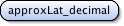
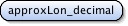
Model approxLat_decimal , approxLon_decimal
Children approxLat_decimal, approxLon_decimal
Instance
<approxLocation>
  <approxLat_decimal>{1,1}</approxLat_decimal>
  <approxLon_decimal>{1,1}</approxLon_decimal>
</approxLocation>
Source
<xs:element name="approxLocation" minOccurs="0">
  <xs:annotation>
    <xs:documentation>for people who want to obfuscate the location</xs:documentation>
  </xs:annotation>
  <xs:complexType>
    <xs:sequence>
      <xs:element name="approxLat_decimal"/>
      <xs:element name="approxLon_decimal"/>
    </xs:sequence>
  </xs:complexType>
</xs:element>
Element WaypointType / approxLocation / approxLat_decimal
Namespace No namespace
Diagram
Diagram
Source
<xs:element name="approxLat_decimal"/>
Element WaypointType / approxLocation / approxLon_decimal
Namespace No namespace
Diagram
Diagram
Source
<xs:element name="approxLon_decimal"/>
Element place / vector
Namespace No namespace
Annotations
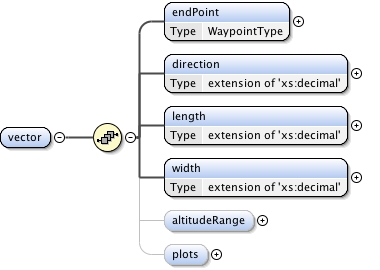
a straight line defined by an endpoint, direction, length and width
Diagram
Diagram sbc_siteDescription_xsd.tmp#id50 sbc_siteDescription_xsd.tmp#id51 sbc_siteDescription_xsd.tmp#id53 sbc_siteDescription_xsd.tmp#id55 sbc_siteDescription_xsd.tmp#id57 sbc_siteDescription_xsd.tmp#id62
Properties
content: complex
Model endPoint , direction , length , width , altitudeRange{0,1} , plots{0,1}
Children altitudeRange, direction, endPoint, length, plots, width
Instance
<vector>
  <endPoint>{1,1}</endPoint>
  <direction unit="">{1,1}</direction>
  <length unit="">{1,1}</length>
  <width unit="">{1,1}</width>
  <altitudeRange datum="" unit="">{0,1}</altitudeRange>
  <plots>{0,1}</plots>
</vector>
Source
<xs:element name="vector">
  <xs:annotation>
    <xs:appinfo>
      <doc:tooltip>Used for a sampling site designated by a starting lat-lon pair, a direction, length and width</doc:tooltip>
      <doc:summary>census transects are usually defined by an endpoint, with a compass direction, length and width. The endpoint is a WaypointType, the direction, length and width are decimals. units are stored in the element's attribute</doc:summary>
    </xs:appinfo>
    <xs:documentation>a straight line defined by an endpoint, direction, length and width</xs:documentation>
  </xs:annotation>
  <xs:complexType>
    <xs:sequence>
      <xs:element name="endPoint" type="WaypointType">
        <xs:annotation>
          <xs:documentation>endpoint is a WaypointType</xs:documentation>
        </xs:annotation>
      </xs:element>
      <xs:element name="direction">
        <xs:complexType>
          <xs:simpleContent>
            <xs:extension base="xs:decimal">
              <xs:attribute name="unit" use="optional"/>
            </xs:extension>
          </xs:simpleContent>
        </xs:complexType>
      </xs:element>
      <xs:element name="length">
        <xs:complexType>
          <xs:simpleContent>
            <xs:extension base="xs:decimal">
              <xs:attribute name="unit" use="optional"/>
            </xs:extension>
          </xs:simpleContent>
        </xs:complexType>
      </xs:element>
      <xs:element name="width">
        <xs:complexType>
          <xs:simpleContent>
            <xs:extension base="xs:decimal">
              <xs:attribute name="unit" use="optional"/>
            </xs:extension>
          </xs:simpleContent>
        </xs:complexType>
      </xs:element>
      <xs:element name="altitudeRange" minOccurs="0">
        <xs:complexType>
          <xs:sequence>
            <xs:element name="minimum" type="xs:decimal"/>
            <xs:element name="maximum" type="xs:decimal"/>
          </xs:sequence>
          <xs:attribute name="datum" type="xs:string" use="optional"/>
          <xs:attribute name="unit" type="xs:string" use="optional"/>
        </xs:complexType>
      </xs:element>
      <xs:element name="plots" minOccurs="0">
        <xs:annotation>
          <xs:appinfo>
            <doc:tooltip>Used for defining plots along a vector-type transect</doc:tooltip>
            <doc:summary>not entirely sure how this information will be used. usually upc data is collected in 1-m quadrats along the same transect as large-animal censuses, alternating sides at approx 5m intervals, and numbered a,b,c or 1,2,3.</doc:summary>
          </xs:appinfo>
          <xs:documentation>maybe remove this, and define plots indivually using locateByReference instead.</xs:documentation>
        </xs:annotation>
        <xs:complexType>
          <xs:sequence>
            <xs:element name="plot" maxOccurs="unbounded">
              <xs:complexType>
                <xs:sequence>
                  <xs:element name="plotName"/>
                  <xs:element name="position"/>
                </xs:sequence>
              </xs:complexType>
            </xs:element>
          </xs:sequence>
        </xs:complexType>
      </xs:element>
    </xs:sequence>
  </xs:complexType>
</xs:element>
Element place / vector / endPoint
Namespace No namespace
Annotations
endpoint is a WaypointType
Diagram
Diagram sbc_siteDescription_xsd.tmp#id25 sbc_siteDescription_xsd.tmp#id33 sbc_siteDescription_xsd.tmp#id43 sbc_siteDescription_xsd.tmp#id46 sbc_siteDescription_xsd.tmp#id24
Type WaypointType
Properties
content: complex
Model gpsLocation{0,1} , (gPoint | gmlPosition) , approxLocation{0,1}
Children approxLocation, gPoint, gmlPosition, gpsLocation
Instance
<endPoint>
  <gpsLocation>{0,1}</gpsLocation>
  <approxLocation>{0,1}</approxLocation>
</endPoint>
Source
<xs:element name="endPoint" type="WaypointType">
  <xs:annotation>
    <xs:documentation>endpoint is a WaypointType</xs:documentation>
  </xs:annotation>
</xs:element>
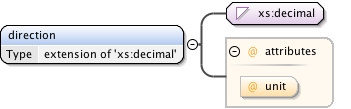
Element place / vector / direction
Namespace No namespace
Diagram
Diagram sbc_siteDescription_xsd.tmp#id52
Type extension of xs:decimal
Properties
content: complex
Attributes
QName Type Fixed Default Use Annotation
unit optional
Source
<xs:element name="direction">
  <xs:complexType>
    <xs:simpleContent>
      <xs:extension base="xs:decimal">
        <xs:attribute name="unit" use="optional"/>
      </xs:extension>
    </xs:simpleContent>
  </xs:complexType>
</xs:element>
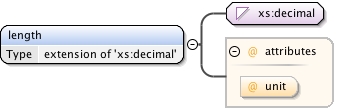
Element place / vector / length
Namespace No namespace
Diagram
Diagram sbc_siteDescription_xsd.tmp#id54
Type extension of xs:decimal
Properties
content: complex
Attributes
QName Type Fixed Default Use Annotation
unit optional
Source
<xs:element name="length">
  <xs:complexType>
    <xs:simpleContent>
      <xs:extension base="xs:decimal">
        <xs:attribute name="unit" use="optional"/>
      </xs:extension>
    </xs:simpleContent>
  </xs:complexType>
</xs:element>
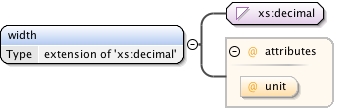
Element place / vector / width
Namespace No namespace
Diagram
Diagram sbc_siteDescription_xsd.tmp#id56
Type extension of xs:decimal
Properties
content: complex
Attributes
QName Type Fixed Default Use Annotation
unit optional
Source
<xs:element name="width">
  <xs:complexType>
    <xs:simpleContent>
      <xs:extension base="xs:decimal">
        <xs:attribute name="unit" use="optional"/>
      </xs:extension>
    </xs:simpleContent>
  </xs:complexType>
</xs:element>
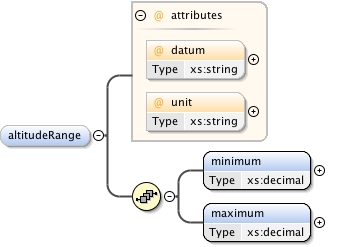
Element place / vector / altitudeRange
Namespace No namespace
Diagram
Diagram sbc_siteDescription_xsd.tmp#id60 sbc_siteDescription_xsd.tmp#id61 sbc_siteDescription_xsd.tmp#id58 sbc_siteDescription_xsd.tmp#id59
Properties
content: complex
minOccurs: 0
Model minimum , maximum
Children maximum, minimum
Instance
<altitudeRange datum="" unit="">
  <minimum>{1,1}</minimum>
  <maximum>{1,1}</maximum>
</altitudeRange>
Attributes
QName Type Fixed Default Use Annotation
datum xs:string optional
unit xs:string optional
Source
<xs:element name="altitudeRange" minOccurs="0">
  <xs:complexType>
    <xs:sequence>
      <xs:element name="minimum" type="xs:decimal"/>
      <xs:element name="maximum" type="xs:decimal"/>
    </xs:sequence>
    <xs:attribute name="datum" type="xs:string" use="optional"/>
    <xs:attribute name="unit" type="xs:string" use="optional"/>
  </xs:complexType>
</xs:element>
Element place / vector / altitudeRange / minimum
Namespace No namespace
Diagram
Diagram
Type xs:decimal
Properties
content: simple
Source
<xs:element name="minimum" type="xs:decimal"/>
Element place / vector / altitudeRange / maximum
Namespace No namespace
Diagram
Diagram
Type xs:decimal
Properties
content: simple
Source
<xs:element name="maximum" type="xs:decimal"/>
Element place / vector / plots
Namespace No namespace
Annotations
maybe remove this, and define plots indivually using locateByReference instead.
Diagram
Diagram sbc_siteDescription_xsd.tmp#id63
Properties
content: complex
minOccurs: 0
Model plot+
Children plot
Instance
<plots>
  <plot>{1,unbounded}</plot>
</plots>
Source
<xs:element name="plots" minOccurs="0">
  <xs:annotation>
    <xs:appinfo>
      <doc:tooltip>Used for defining plots along a vector-type transect</doc:tooltip>
      <doc:summary>not entirely sure how this information will be used. usually upc data is collected in 1-m quadrats along the same transect as large-animal censuses, alternating sides at approx 5m intervals, and numbered a,b,c or 1,2,3.</doc:summary>
    </xs:appinfo>
    <xs:documentation>maybe remove this, and define plots indivually using locateByReference instead.</xs:documentation>
  </xs:annotation>
  <xs:complexType>
    <xs:sequence>
      <xs:element name="plot" maxOccurs="unbounded">
        <xs:complexType>
          <xs:sequence>
            <xs:element name="plotName"/>
            <xs:element name="position"/>
          </xs:sequence>
        </xs:complexType>
      </xs:element>
    </xs:sequence>
  </xs:complexType>
</xs:element>
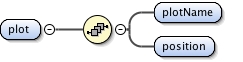
Element place / vector / plots / plot
Namespace No namespace
Diagram
Diagram sbc_siteDescription_xsd.tmp#id64 sbc_siteDescription_xsd.tmp#id65
Properties
content: complex
maxOccurs: unbounded
Model plotName , position
Children plotName, position
Instance
<plot>
  <plotName>{1,1}</plotName>
  <position>{1,1}</position>
</plot>
Source
<xs:element name="plot" maxOccurs="unbounded">
  <xs:complexType>
    <xs:sequence>
      <xs:element name="plotName"/>
      <xs:element name="position"/>
    </xs:sequence>
  </xs:complexType>
</xs:element>
Element place / vector / plots / plot / plotName
Namespace No namespace
Diagram
Diagram
Source
<xs:element name="plotName"/>
Element place / vector / plots / plot / position
Namespace No namespace
Diagram
Diagram
Source
<xs:element name="position"/>
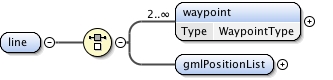
Element place / line
Namespace No namespace
Annotations
a string of at least 2 waypoints, or an unclosed curve
Diagram
Diagram sbc_siteDescription_xsd.tmp#id67 sbc_siteDescription_xsd.tmp#id68
Properties
content: complex
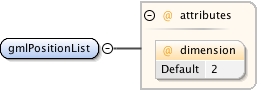
Model waypoint{2,unbounded} | gmlPositionList
Children gmlPositionList, waypoint
Instance
<line>
  <waypoint>{2,unbounded}</waypoint>
  <gmlPositionList dimension="2">{1,1}</gmlPositionList>
</line>
Source
<xs:element name="line">
  <xs:annotation>
    <xs:appinfo>
      <doc:tooltip>Describe a line or sampling transect by one or more lat-lon pairs</doc:tooltip>
      <doc:summary>This tree could be used for any sampling line composed of at least 2 endpoints (and may include jogs). examples are ship transects, along shore transects. Tree can aslo be used for creeks or tributaries. Use either a sequence of GPointTypes, or a gml lineString (called a PositionList here)</doc:summary>
    </xs:appinfo>
    <xs:documentation>a string of at least 2 waypoints, or an unclosed curve</xs:documentation>
  </xs:annotation>
  <xs:complexType>
    <xs:choice>
      <xs:element name="waypoint" type="WaypointType" minOccurs="2" maxOccurs="unbounded"/>
      <xs:element name="gmlPositionList">
        <xs:annotation>
          <xs:appinfo>
            <doc:tooltip>an alternative to separately coded lats and longs. gml string could go here</doc:tooltip>
            <doc:summary>This field should be composed of at least 2 "lon lat" pairs (ie, x y, x y, x y) to denone. same caveats apply as for gmlPosition</doc:summary>
            <doc:example>-120.8678 34.2222, -120.9000, 34.333</doc:example>
          </xs:appinfo>
        </xs:annotation>
        <xs:complexType>
          <xs:attribute name="dimension" default="2"/>
        </xs:complexType>
      </xs:element>
    </xs:choice>
  </xs:complexType>
</xs:element>
Element place / line / waypoint
Namespace No namespace
Diagram
Diagram sbc_siteDescription_xsd.tmp#id25 sbc_siteDescription_xsd.tmp#id33 sbc_siteDescription_xsd.tmp#id43 sbc_siteDescription_xsd.tmp#id46 sbc_siteDescription_xsd.tmp#id24
Type WaypointType
Properties
content: complex
minOccurs: 2
maxOccurs: unbounded
Model gpsLocation{0,1} , (gPoint | gmlPosition) , approxLocation{0,1}
Children approxLocation, gPoint, gmlPosition, gpsLocation
Instance
<waypoint>
  <gpsLocation>{0,1}</gpsLocation>
  <approxLocation>{0,1}</approxLocation>
</waypoint>
Source
<xs:element name="waypoint" type="WaypointType" minOccurs="2" maxOccurs="unbounded"/>
Element place / line / gmlPositionList
Namespace No namespace
Diagram
Diagram sbc_siteDescription_xsd.tmp#id69
Properties
content: complex
Attributes
QName Type Fixed Default Use Annotation
dimension 2 optional
Source
<xs:element name="gmlPositionList">
  <xs:annotation>
    <xs:appinfo>
      <doc:tooltip>an alternative to separately coded lats and longs. gml string could go here</doc:tooltip>
      <doc:summary>This field should be composed of at least 2 "lon lat" pairs (ie, x y, x y, x y) to denone. same caveats apply as for gmlPosition</doc:summary>
      <doc:example>-120.8678 34.2222, -120.9000, 34.333</doc:example>
    </xs:appinfo>
  </xs:annotation>
  <xs:complexType>
    <xs:attribute name="dimension" default="2"/>
  </xs:complexType>
</xs:element>
Element place / polygon
Namespace No namespace
Annotations
a closed shape with/without an excluded area
Diagram
Diagram sbc_siteDescription_xsd.tmp#id71 sbc_siteDescription_xsd.tmp#id74
Properties
content: complex
Model gPolygonOuterGRing , gPolygonExclusionGRing*
Children gPolygonExclusionGRing, gPolygonOuterGRing
Instance
<polygon>
  <gPolygonOuterGRing>{1,1}</gPolygonOuterGRing>
  <gPolygonExclusionGRing>{0,unbounded}</gPolygonExclusionGRing>
</polygon>
Source
<xs:element name="polygon">
  <xs:annotation>
    <xs:appinfo>
      <doc:tooltip>Polygon data set</doc:tooltip>
      <doc:summary>This construct creates a spatial ring with a hollow center.</doc:summary>
      <doc:description>This construct creates a spatial ring with a hollow center.  This doughnut shape is specified by the outer ring (datasetGPolygonOuterRing) and the inner exclusion zone (datasetGPolygonExclusionGRing) which can be thought of as the hole in the center of a doughnut.  This is useful for defining areas such as the shores of a pond where you only want to specify the shore excluding the pond itself.</doc:description>
      <doc:example>Please see the individual sub-fields for specificexamples.</doc:example>
    </xs:appinfo>
    <xs:documentation>a closed shape with/without an excluded area</xs:documentation>
  </xs:annotation>
  <xs:complexType>
    <xs:sequence>
      <xs:element name="gPolygonOuterGRing">
        <xs:annotation>
          <xs:appinfo>
            <doc:tooltip>Outer polygon</doc:tooltip>
            <doc:summary>The outer containment loop of a GPolygon.</doc:summary>
            <doc:description>The outer containment loop of a datasetGPolygon.  This is the outer part of the doughnut shape that encompasses the broadest area of coverage</doc:description>
          </xs:appinfo>
        </xs:annotation>
        <xs:complexType>
          <xs:choice>
            <xs:sequence>
              <xs:element name="gPoint" type="GPointType" minOccurs="3" maxOccurs="unbounded"/>
            </xs:sequence>
            <xs:element name="gmlRing"/>
          </xs:choice>
        </xs:complexType>
      </xs:element>
      <xs:element name="gPolygonExclusionGRing" minOccurs="0" maxOccurs="unbounded">
        <xs:annotation>
          <xs:appinfo>
            <doc:tooltip>Exclusion polygon</doc:tooltip>
            <doc:summary>Data Set G-Polygon Exclusion G-Ring, the closed nonintersecting boundary of a void area (or hole in an interior area).</doc:summary>
            <doc:description>Data Set G-Polygon Exclusion G-Ring, the closed nonintersecting boundary of a void area (or hole in an interior area).  This is the center of the doughnut shape created by the datasetGPolygon. How do you inforce non-intersecting??</doc:description>
          </xs:appinfo>
          <xs:documentation>the void area, or center of the doughnut.</xs:documentation>
        </xs:annotation>
        <xs:complexType>
          <xs:choice>
            <xs:element name="gPoint" type="GPointType" maxOccurs="unbounded"/>
            <xs:element name="gmlRing"/>
          </xs:choice>
        </xs:complexType>
      </xs:element>
    </xs:sequence>
  </xs:complexType>
</xs:element>
Element place / polygon / gPolygonOuterGRing
Namespace No namespace
Diagram
Diagram sbc_siteDescription_xsd.tmp#id72 sbc_siteDescription_xsd.tmp#id73
Properties
content: complex
Model (gPoint{3,unbounded}) | gmlRing
Children gPoint, gmlRing
Instance
<gPolygonOuterGRing>
  <gPoint>{3,unbounded}</gPoint>
  <gmlRing>{1,1}</gmlRing>
</gPolygonOuterGRing>
Source
<xs:element name="gPolygonOuterGRing">
  <xs:annotation>
    <xs:appinfo>
      <doc:tooltip>Outer polygon</doc:tooltip>
      <doc:summary>The outer containment loop of a GPolygon.</doc:summary>
      <doc:description>The outer containment loop of a datasetGPolygon.  This is the outer part of the doughnut shape that encompasses the broadest area of coverage</doc:description>
    </xs:appinfo>
  </xs:annotation>
  <xs:complexType>
    <xs:choice>
      <xs:sequence>
        <xs:element name="gPoint" type="GPointType" minOccurs="3" maxOccurs="unbounded"/>
      </xs:sequence>
      <xs:element name="gmlRing"/>
    </xs:choice>
  </xs:complexType>
</xs:element>
Element place / polygon / gPolygonOuterGRing / gPoint
Namespace No namespace
Diagram
Diagram sbc_siteDescription_xsd.tmp#id35 sbc_siteDescription_xsd.tmp#id40 sbc_siteDescription_xsd.tmp#id34
Type GPointType
Properties
content: complex
minOccurs: 3
maxOccurs: unbounded
Model gPointXY , gPointZ{0,1}
Children gPointXY, gPointZ
Instance
<gPoint>
  <gPointXY datum="" unit="degree">{1,1}</gPointXY>
  <gPointZ datum="" unit="meter">{0,1}</gPointZ>
</gPoint>
Source
<xs:element name="gPoint" type="GPointType" minOccurs="3" maxOccurs="unbounded"/>
Element place / polygon / gPolygonOuterGRing / gmlRing
Namespace No namespace
Diagram
Diagram
Source
<xs:element name="gmlRing"/>
Element place / polygon / gPolygonExclusionGRing
Namespace No namespace
Annotations
the void area, or center of the doughnut.
Diagram
Diagram sbc_siteDescription_xsd.tmp#id75 sbc_siteDescription_xsd.tmp#id76
Properties
content: complex
minOccurs: 0
maxOccurs: unbounded
Model gPoint+ | gmlRing
Children gPoint, gmlRing
Instance
<gPolygonExclusionGRing>
  <gPoint>{1,unbounded}</gPoint>
  <gmlRing>{1,1}</gmlRing>
</gPolygonExclusionGRing>
Source
<xs:element name="gPolygonExclusionGRing" minOccurs="0" maxOccurs="unbounded">
  <xs:annotation>
    <xs:appinfo>
      <doc:tooltip>Exclusion polygon</doc:tooltip>
      <doc:summary>Data Set G-Polygon Exclusion G-Ring, the closed nonintersecting boundary of a void area (or hole in an interior area).</doc:summary>
      <doc:description>Data Set G-Polygon Exclusion G-Ring, the closed nonintersecting boundary of a void area (or hole in an interior area).  This is the center of the doughnut shape created by the datasetGPolygon. How do you inforce non-intersecting??</doc:description>
    </xs:appinfo>
    <xs:documentation>the void area, or center of the doughnut.</xs:documentation>
  </xs:annotation>
  <xs:complexType>
    <xs:choice>
      <xs:element name="gPoint" type="GPointType" maxOccurs="unbounded"/>
      <xs:element name="gmlRing"/>
    </xs:choice>
  </xs:complexType>
</xs:element>
Element place / polygon / gPolygonExclusionGRing / gPoint
Namespace No namespace
Diagram
Diagram sbc_siteDescription_xsd.tmp#id35 sbc_siteDescription_xsd.tmp#id40 sbc_siteDescription_xsd.tmp#id34
Type GPointType
Properties
content: complex
maxOccurs: unbounded
Model gPointXY , gPointZ{0,1}
Children gPointXY, gPointZ
Instance
<gPoint>
  <gPointXY datum="" unit="degree">{1,1}</gPointXY>
  <gPointZ datum="" unit="meter">{0,1}</gPointZ>
</gPoint>
Source
<xs:element name="gPoint" type="GPointType" maxOccurs="unbounded"/>
Element place / polygon / gPolygonExclusionGRing / gmlRing
Namespace No namespace
Diagram
Diagram
Source
<xs:element name="gmlRing"/>
Element place / boundingBox
Namespace No namespace
Annotations
copied from EML geographicCoverage, 
but altitude moved and datums added
Diagram
Diagram sbc_siteDescription_xsd.tmp#id78 sbc_siteDescription_xsd.tmp#id84
Properties
content: complex
Model boundingCoordinates , boundingAltitudes{0,1}
Children boundingAltitudes, boundingCoordinates
Instance
<boundingBox>
  <boundingCoordinates datum="">{1,1}</boundingCoordinates>
  <boundingAltitudes datum="">{0,1}</boundingAltitudes>
</boundingBox>
Source
<xs:element name="boundingBox">
  <xs:annotation>
    <xs:documentation>copied from EML geographicCoverage, 
              but altitude moved and datums added</xs:documentation>
  </xs:annotation>
  <xs:complexType>
    <xs:sequence>
      <xs:element name="boundingCoordinates">
        <xs:complexType>
          <xs:sequence>
            <xs:element name="westBoundingCoordinate" type="xs:string"/>
            <xs:element name="eastBoundingCoordinate" type="xs:string"/>
            <xs:element name="northBoundingCoordinate" type="xs:string"/>
            <xs:element name="southBoundingCoordinate" type="xs:string"/>
          </xs:sequence>
          <xs:attribute name="datum" use="optional"/>
        </xs:complexType>
      </xs:element>
      <xs:element name="boundingAltitudes" minOccurs="0">
        <xs:complexType>
          <xs:sequence>
            <xs:element name="altitudeMinimum" type="xs:string"/>
            <xs:element name="altitudeMaximum" type="xs:string"/>
            <xs:element name="altitudeUnits" type="xs:string"/>
          </xs:sequence>
          <xs:attribute name="datum" use="optional"/>
        </xs:complexType>
      </xs:element>
    </xs:sequence>
  </xs:complexType>
</xs:element>
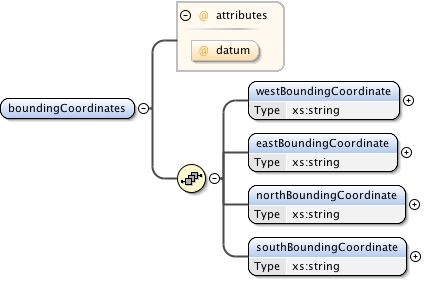
Element place / boundingBox / boundingCoordinates
Namespace No namespace
Diagram
Diagram sbc_siteDescription_xsd.tmp#id83 sbc_siteDescription_xsd.tmp#id79 sbc_siteDescription_xsd.tmp#id80 sbc_siteDescription_xsd.tmp#id81 sbc_siteDescription_xsd.tmp#id82
Properties
content: complex
Model westBoundingCoordinate , eastBoundingCoordinate , northBoundingCoordinate , southBoundingCoordinate
Children eastBoundingCoordinate, northBoundingCoordinate, southBoundingCoordinate, westBoundingCoordinate
Instance
<boundingCoordinates datum="">
  <westBoundingCoordinate>{1,1}</westBoundingCoordinate>
  <eastBoundingCoordinate>{1,1}</eastBoundingCoordinate>
  <northBoundingCoordinate>{1,1}</northBoundingCoordinate>
  <southBoundingCoordinate>{1,1}</southBoundingCoordinate>
</boundingCoordinates>
Attributes
QName Type Fixed Default Use Annotation
datum optional
Source
<xs:element name="boundingCoordinates">
  <xs:complexType>
    <xs:sequence>
      <xs:element name="westBoundingCoordinate" type="xs:string"/>
      <xs:element name="eastBoundingCoordinate" type="xs:string"/>
      <xs:element name="northBoundingCoordinate" type="xs:string"/>
      <xs:element name="southBoundingCoordinate" type="xs:string"/>
    </xs:sequence>
    <xs:attribute name="datum" use="optional"/>
  </xs:complexType>
</xs:element>
Element place / boundingBox / boundingCoordinates / westBoundingCoordinate
Namespace No namespace
Diagram
Diagram
Type xs:string
Properties
content: simple
Source
<xs:element name="westBoundingCoordinate" type="xs:string"/>
Element place / boundingBox / boundingCoordinates / eastBoundingCoordinate
Namespace No namespace
Diagram
Diagram
Type xs:string
Properties
content: simple
Source
<xs:element name="eastBoundingCoordinate" type="xs:string"/>
Element place / boundingBox / boundingCoordinates / northBoundingCoordinate
Namespace No namespace
Diagram
Diagram
Type xs:string
Properties
content: simple
Source
<xs:element name="northBoundingCoordinate" type="xs:string"/>
Element place / boundingBox / boundingCoordinates / southBoundingCoordinate
Namespace No namespace
Diagram
Diagram
Type xs:string
Properties
content: simple
Source
<xs:element name="southBoundingCoordinate" type="xs:string"/>
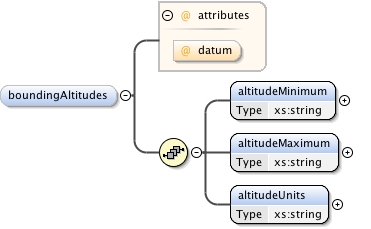
Element place / boundingBox / boundingAltitudes
Namespace No namespace
Diagram
Diagram sbc_siteDescription_xsd.tmp#id88 sbc_siteDescription_xsd.tmp#id85 sbc_siteDescription_xsd.tmp#id86 sbc_siteDescription_xsd.tmp#id87
Properties
content: complex
minOccurs: 0
Model altitudeMinimum , altitudeMaximum , altitudeUnits
Children altitudeMaximum, altitudeMinimum, altitudeUnits
Instance
<boundingAltitudes datum="">
  <altitudeMinimum>{1,1}</altitudeMinimum>
  <altitudeMaximum>{1,1}</altitudeMaximum>
  <altitudeUnits>{1,1}</altitudeUnits>
</boundingAltitudes>
Attributes
QName Type Fixed Default Use Annotation
datum optional
Source
<xs:element name="boundingAltitudes" minOccurs="0">
  <xs:complexType>
    <xs:sequence>
      <xs:element name="altitudeMinimum" type="xs:string"/>
      <xs:element name="altitudeMaximum" type="xs:string"/>
      <xs:element name="altitudeUnits" type="xs:string"/>
    </xs:sequence>
    <xs:attribute name="datum" use="optional"/>
  </xs:complexType>
</xs:element>
Element place / boundingBox / boundingAltitudes / altitudeMinimum
Namespace No namespace
Diagram
Diagram
Type xs:string
Properties
content: simple
Source
<xs:element name="altitudeMinimum" type="xs:string"/>
Element place / boundingBox / boundingAltitudes / altitudeMaximum
Namespace No namespace
Diagram
Diagram
Type xs:string
Properties
content: simple
Source
<xs:element name="altitudeMaximum" type="xs:string"/>
Element place / boundingBox / boundingAltitudes / altitudeUnits
Namespace No namespace
Diagram
Diagram
Type xs:string
Properties
content: simple
Source
<xs:element name="altitudeUnits" type="xs:string"/>
Element place / locateByReference
Namespace No namespace
Annotations
describe this place using its relationship to another place. no attempt at referential integrity.
Diagram
Diagram sbc_siteDescription_xsd.tmp#id90 sbc_siteDescription_xsd.tmp#id93
Properties
content: complex
Model referenceIdentifier , locatorString
Children locatorString, referenceIdentifier
Instance
<locateByReference>
  <referenceIdentifier scope="" system="">{1,1}</referenceIdentifier>
  <locatorString>{1,1}</locatorString>
</locateByReference>
Source
<xs:element name="locateByReference">
  <xs:annotation>
    <xs:appinfo>
      <doc:tooltip>an alternative to separately coded lats and longs. Use this element for a point that is located by reference to another place</doc:tooltip>
      <doc:summary>locations can be specified as "8meters along transect A", or "from aqm, 10meters at 340deg".  transect A (or aqm) are places with existing descriptions</doc:summary>
      <doc:example>10 ft SW of the big rock at the foot of goleta pier</doc:example>
      <doc:example>8meters along transect LTRAQ1</doc:example>
    </xs:appinfo>
    <xs:documentation>describe this place using its relationship to another place. no attempt at referential integrity.</xs:documentation>
  </xs:annotation>
  <xs:complexType>
    <xs:sequence>
      <xs:element name="referenceIdentifier">
        <xs:annotation>
          <xs:appinfo>
            <doc:tooltip>The id of the place that will be referenced</doc:tooltip>
            <doc:summary>the parent place of this place. for example, the id for the transect that this plot is located along</doc:summary>
            <doc:example>LTRAQ1</doc:example>
          </xs:appinfo>
          <xs:documentation>The id of the place that will be referenced</xs:documentation>
        </xs:annotation>
        <xs:complexType>
          <xs:attribute name="system"/>
          <xs:attribute name="scope"/>
        </xs:complexType>
      </xs:element>
      <xs:element name="locatorString">
        <xs:annotation>
          <xs:documentation>How to find this place from the reference place</xs:documentation>
          <xs:appinfo>
            <doc:tooltip>How to find this place from the reference place</doc:tooltip>
            <doc:summary>This element typed xs:string to accomodate narrative descriptions</doc:summary>
            <doc:example>10m at 340deg</doc:example>
            <doc:example>8m</doc:example>
          </xs:appinfo>
        </xs:annotation>
      </xs:element>
    </xs:sequence>
  </xs:complexType>
</xs:element>
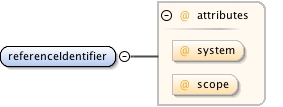
Element place / locateByReference / referenceIdentifier
Namespace No namespace
Annotations
The id of the place that will be referenced
Diagram
Diagram sbc_siteDescription_xsd.tmp#id91 sbc_siteDescription_xsd.tmp#id92
Properties
content: complex
Attributes
QName Type Fixed Default Use Annotation
scope optional
system optional
Source
<xs:element name="referenceIdentifier">
  <xs:annotation>
    <xs:appinfo>
      <doc:tooltip>The id of the place that will be referenced</doc:tooltip>
      <doc:summary>the parent place of this place. for example, the id for the transect that this plot is located along</doc:summary>
      <doc:example>LTRAQ1</doc:example>
    </xs:appinfo>
    <xs:documentation>The id of the place that will be referenced</xs:documentation>
  </xs:annotation>
  <xs:complexType>
    <xs:attribute name="system"/>
    <xs:attribute name="scope"/>
  </xs:complexType>
</xs:element>
Element place / locateByReference / locatorString
Namespace No namespace
Annotations
How to find this place from the reference place
Diagram
Diagram
Source
<xs:element name="locatorString">
  <xs:annotation>
    <xs:documentation>How to find this place from the reference place</xs:documentation>
    <xs:appinfo>
      <doc:tooltip>How to find this place from the reference place</doc:tooltip>
      <doc:summary>This element typed xs:string to accomodate narrative descriptions</doc:summary>
      <doc:example>10m at 340deg</doc:example>
      <doc:example>8m</doc:example>
    </xs:appinfo>
  </xs:annotation>
</xs:element>
Element place / imageLocation
Namespace No namespace
Annotations
path on the file server or a url
Diagram
Diagram
Properties
minOccurs: 0
maxOccurs: unbounded
Source
<xs:element name="imageLocation" minOccurs="0" maxOccurs="unbounded">
  <xs:annotation>
    <xs:documentation>path on the file server or a url</xs:documentation>
    <xs:appinfo>
      <doc:tooltip>a path to an image file to accompany this place, either on the fileserver or a url</doc:tooltip>
      <doc:summary>Some site description documents contain a small image or a crude map of the site. these should be converted to standard image formats.</doc:summary>
      <doc:example>/internal//reef/working/site_descriptions/ab04.jog</doc:example>
      <doc:example>8m</doc:example>
    </xs:appinfo>
  </xs:annotation>
</xs:element>
Complex Type WaypointType
Namespace No namespace
Annotations
a single point location
Diagram
Diagram sbc_siteDescription_xsd.tmp#id25 sbc_siteDescription_xsd.tmp#id33 sbc_siteDescription_xsd.tmp#id43 sbc_siteDescription_xsd.tmp#id46
Used by
Model gpsLocation{0,1} , (gPoint | gmlPosition) , approxLocation{0,1}
Children approxLocation, gPoint, gmlPosition, gpsLocation
Source
<xs:complexType name="WaypointType">
  <xs:annotation>
    <xs:appinfo>
      <doc:tooltip>Used for a sampling site designated by a  lat-lon pair</doc:tooltip>
      <doc:summary>like a cruise sampling station, or mooring</doc:summary>
    </xs:appinfo>
    <xs:documentation>a single point location</xs:documentation>
  </xs:annotation>
  <xs:sequence>
    <xs:element name="gpsLocation" minOccurs="0">
      <xs:annotation>
        <xs:documentation>The point as it came off the gps unit. these fields can be transformed into gPoints</xs:documentation>
      </xs:annotation>
      <xs:complexType>
        <xs:sequence>
          <xs:element name="lat" type="gpsCoordinate"/>
          <xs:element name="lon" type="gpsCoordinate"/>
        </xs:sequence>
      </xs:complexType>
    </xs:element>
    <xs:choice>
      <xs:element name="gPoint">
        <xs:complexType>
          <xs:complexContent>
            <xs:extension base="GPointType"/>
          </xs:complexContent>
        </xs:complexType>
      </xs:element>
      <xs:element name="gmlPosition">
        <xs:annotation>
          <xs:appinfo>
            <doc:tooltip>an alternative to separately coded lats and longs. gml string could go here</doc:tooltip>
            <doc:summary>This field should be a "lon lat" pair (ie, x y, if 2D), or a "lon lat alt" (x y z, if 3D). consider a validation pattern, like counting the commas and spaces</doc:summary>
            <doc:example>34.2222 120.8678</doc:example>
          </xs:appinfo>
        </xs:annotation>
        <xs:complexType>
          <xs:attribute name="dimension" default="2"/>
          <xs:attribute name="coordSystem"/>
        </xs:complexType>
      </xs:element>
    </xs:choice>
    <xs:element name="approxLocation" minOccurs="0">
      <xs:annotation>
        <xs:documentation>for people who want to obfuscate the location</xs:documentation>
      </xs:annotation>
      <xs:complexType>
        <xs:sequence>
          <xs:element name="approxLat_decimal"/>
          <xs:element name="approxLon_decimal"/>
        </xs:sequence>
      </xs:complexType>
    </xs:element>
  </xs:sequence>
</xs:complexType>
Complex Type gpsCoordinate
Namespace No namespace
Annotations
either the x or y coordinate, 2 will be required
Diagram
Diagram sbc_siteDescription_xsd.tmp#id31 sbc_siteDescription_xsd.tmp#id28 sbc_siteDescription_xsd.tmp#id29 sbc_siteDescription_xsd.tmp#id30
Used by
Model degrees_integer , minutes_decimal , compass_pt
Children compass_pt, degrees_integer, minutes_decimal
Attributes
QName Type Fixed Default Use Annotation
datum optional
Source
<xs:complexType name="gpsCoordinate">
  <xs:annotation>
    <xs:documentation>either the x or y coordinate, 2 will be required</xs:documentation>
  </xs:annotation>
  <xs:sequence>
    <xs:element name="degrees_integer" type="xs:integer"/>
    <xs:element name="minutes_decimal" type="xs:decimal"/>
    <xs:element name="compass_pt"/>
  </xs:sequence>
  <xs:attribute name="datum" use="optional"/>
</xs:complexType>
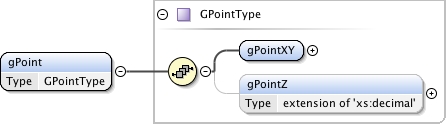
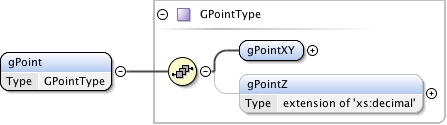
Complex Type GPointType
Namespace No namespace
Diagram
Diagram sbc_siteDescription_xsd.tmp#id35 sbc_siteDescription_xsd.tmp#id40
Used by
Model gPointXY , gPointZ{0,1}
Children gPointXY, gPointZ
Source
<xs:complexType name="GPointType">
  <xs:annotation>
    <xs:appinfo>
      <doc:tooltip>G point</doc:tooltip>
      <doc:summary>A single geographic location.</doc:summary>
      <doc:description>A single geographic location.  This is useful if you register your datasets by a single geospatial point, such as the lat/long of a sampling site or station. Apps will assume decimal degrees, positive for North and East, negative for South and West. The default datum for xy- coordinates is WGS87, used by gps systems</doc:description>
    </xs:appinfo>
  </xs:annotation>
  <xs:sequence>
    <xs:element name="gPointXY">
      <xs:complexType>
        <xs:sequence>
          <xs:element name="gPointLatitude" type="xs:decimal">
            <xs:annotation>
              <xs:appinfo>
                <doc:tooltip>G-Point Latitude</doc:tooltip>
                <doc:summary/>
                <doc:description>The latitude of a point. Use decimal degrees, positive = North</doc:description>
              </xs:appinfo>
            </xs:annotation>
          </xs:element>
          <xs:element name="gPointLongitude" type="xs:decimal">
            <xs:annotation>
              <xs:appinfo>
                <doc:tooltip>G-Point Longitude</doc:tooltip>
                <doc:summary/>
                <doc:description>The longitude of a point Use decimal degrees, positive = East.</doc:description>
              </xs:appinfo>
            </xs:annotation>
          </xs:element>
        </xs:sequence>
        <xs:attribute name="datum" use="optional"/>
        <xs:attribute name="unit" default="degree"/>
      </xs:complexType>
    </xs:element>
    <xs:element name="gPointZ" minOccurs="0">
      <xs:complexType>
        <xs:simpleContent>
          <xs:extension base="xs:decimal">
            <xs:attribute name="datum" use="optional"/>
            <xs:attribute name="unit" default="meter"/>
          </xs:extension>
        </xs:simpleContent>
      </xs:complexType>
    </xs:element>
  </xs:sequence>
</xs:complexType>
Attribute place / alternateIdentifier / @system
Namespace No namespace
Type SystemType
Properties
use: optional
Used by
Source
<xs:attribute name="system" type="res:SystemType" use="optional"/>
Attribute place / alternateIdentifier / @scope
Namespace No namespace
Type ScopeType
Properties
use: optional
default: document
Facets
enumeration system
enumeration document
Used by
Source
<xs:attribute name="scope" type="res:ScopeType" use="optional" default="document"/>
Attribute place / verbatim / @date
Namespace No namespace
Type xs:date
Properties
use: optional
Used by
Element place/verbatim
Source
<xs:attribute name="date" type="xs:date" use="optional"/>
Attribute place / verbatim / @useType
Namespace No namespace
Type xs:string
Properties
use: optional
Used by
Element place/verbatim
Source
<xs:attribute name="useType" type="xs:string" use="optional"/>
Attribute gpsCoordinate / @datum
Namespace No namespace
Properties
use: optional
Used by
Complex Type gpsCoordinate
Source
<xs:attribute name="datum" use="optional"/>
Attribute GPointType / gPointXY / @datum
Namespace No namespace
Properties
use: optional
Used by
Source
<xs:attribute name="datum" use="optional"/>
Attribute GPointType / gPointXY / @unit
Namespace No namespace
Properties
default: degree
Used by
Source
<xs:attribute name="unit" default="degree"/>
Attribute GPointType / gPointZ / @datum
Namespace No namespace
Properties
use: optional
Used by
Source
<xs:attribute name="datum" use="optional"/>
Attribute GPointType / gPointZ / @unit
Namespace No namespace
Properties
default: meter
Used by
Source
<xs:attribute name="unit" default="meter"/>
Attribute WaypointType / gmlPosition / @dimension
Namespace No namespace
Properties
default: 2
Used by
Source
<xs:attribute name="dimension" default="2"/>
Attribute WaypointType / gmlPosition / @coordSystem
Namespace No namespace
Used by
Source
<xs:attribute name="coordSystem"/>
Attribute place / vector / direction / @unit
Namespace No namespace
Properties
use: optional
Used by
Source
<xs:attribute name="unit" use="optional"/>
Attribute place / vector / length / @unit
Namespace No namespace
Properties
use: optional
Used by
Source
<xs:attribute name="unit" use="optional"/>
Attribute place / vector / width / @unit
Namespace No namespace
Properties
use: optional
Used by
Source
<xs:attribute name="unit" use="optional"/>
Attribute place / vector / altitudeRange / @datum
Namespace No namespace
Type xs:string
Properties
use: optional
Used by
Source
<xs:attribute name="datum" type="xs:string" use="optional"/>
Attribute place / vector / altitudeRange / @unit
Namespace No namespace
Type xs:string
Properties
use: optional
Used by
Source
<xs:attribute name="unit" type="xs:string" use="optional"/>
Attribute place / line / gmlPositionList / @dimension
Namespace No namespace
Properties
default: 2
Used by
Source
<xs:attribute name="dimension" default="2"/>
Attribute place / boundingBox / boundingCoordinates / @datum
Namespace No namespace
Properties
use: optional
Used by
Source
<xs:attribute name="datum" use="optional"/>
Attribute place / boundingBox / boundingAltitudes / @datum
Namespace No namespace
Properties
use: optional
Used by
Source
<xs:attribute name="datum" use="optional"/>
Attribute place / locateByReference / referenceIdentifier / @system
Namespace No namespace
Used by
Source
<xs:attribute name="system"/>
Attribute place / locateByReference / referenceIdentifier / @scope
Namespace No namespace
Used by
Source
<xs:attribute name="scope"/>
Attribute place / @siteid
Namespace No namespace
Used by
Element place
Source
<xs:attribute name="siteid"/>
Attribute place / @system
Namespace No namespace
Type SystemType
Properties
use: optional
Used by
Element place
Source
<xs:attribute name="system" type="res:SystemType" use="optional"/>
Attribute place / @scope
Namespace No namespace
Type ScopeType
Properties
use: optional
default: document
Facets
enumeration system
enumeration document
Used by
Element place
Source
<xs:attribute name="scope" type="res:ScopeType" use="optional" default="document"/>